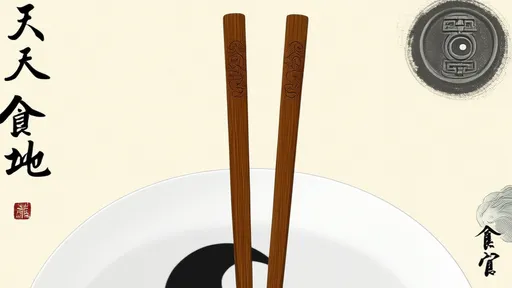
The humble chopstick, an eating utensil used by billions across East Asia, carries far deeper cultural symbolism than its simple form suggests. Among the most profound meanings lies in the traditional design of square heads and round tails - a subtle representation of ancient Chinese cosmology that has endured for millennia.
To understand this symbolism, we must journey back to ancient Chinese philosophy where the square represented Earth and the circle symbolized Heaven. This "round Heaven, square Earth" concept (天圆地方) formed a cornerstone of classical Chinese thought, influencing everything from architecture to currency. The chopstick's design quietly embodies this worldview, turning each meal into a small act of cosmic harmony.
The square head of the chopstick, typically measuring about 0.6 cm per side, connects practically with its function. The flat edges prevent rolling when placed on tables and provide better grip stability. Symbolically, these straight lines and right angles mirror the perceived nature of Earth - stable, measurable, and bound by the four directions (north, south, east, west). Ancient Chinese observed that crops grew in rectangular fields, cities were laid out in grid patterns, and the Earth's changes followed predictable, "square" rhythms of seasons.
In contrast, the round tail represents the celestial realm. The smooth, infinite curve reflects the cyclical nature of heavenly bodies - the sun's daily journey, the moon's phases, the stars' eternal rotations. Unlike the measurable Earth, Heaven was considered mysterious, boundless, and constantly moving. The circular section also fits comfortably in the hand, suggesting humanity's connection to the cosmos through the simple act of eating.
This design philosophy extends beyond mere shape. Traditional chopsticks maintain specific length proportions - typically 7 Chinese inches (about 23 cm) long, representing the seven visible celestial bodies (sun, moon, and five classical planets). The standard pair symbolizes the dual forces of yin and yang, working in harmony to nourish life. When held properly, they create a triangle with the forearm, representing the unity of Heaven, Earth, and Humanity.
Historical records suggest this symbolism became standardized during the Han Dynasty (206 BCE-220 CE), when Confucian thought dominated court rituals. Banquets became highly ceremonial, and every utensil carried philosophical meaning. The square-to-round transition in chopsticks often occurs at the precise midpoint, reflecting the ancient belief that Earth sat below Heaven's dome at the universe's center.
Modern manufacturing has made perfectly cylindrical chopsticks more common, especially disposable varieties. However, traditional restaurants, particularly those serving imperial cuisine or hosting important ceremonies, still prefer the classic design. In Japan, the practice survives in lacquered chopsticks where the thicker end remains rounded while the eating end becomes subtly squared. Korean metal chopsticks often maintain flat rectangular profiles while tapering to rounded tips.
This cultural coding extends to chopstick etiquette. Placing them parallel (rather than crossed) respects the orderly Earth-Heaven relationship. Pointing chopsticks violates the harmony, as does sticking them vertically into rice - a gesture resembling incense sticks for the dead. Even the materials carry meaning: bamboo represents resilience (Earth), while ivory symbolized celestial purity (Heaven) before its ban.
Contemporary designers have reinterpreted this symbolism. Some create chopsticks with celestial maps engraved on round ends and agricultural motifs on square heads. Others use the transition from square to circle to represent modern China's journey from traditional roots to global engagement. Yet the essential philosophy remains - that even mundane objects can connect daily life to universal principles.
Next time you pick up a pair of properly crafted chopsticks, consider how this simple utensil encapsulates an entire worldview. In that moment, your hand bridges Earth and Heaven, continuing a cultural conversation that has nourished both body and spirit for over two thousand years. The persistence of this design reminds us that in Chinese tradition, even the act of eating carries profound cosmological significance.
By /Aug 11, 2025
By /Aug 11, 2025
By /Aug 11, 2025
By /Aug 11, 2025
By /Aug 11, 2025
By /Aug 11, 2025
By /Aug 11, 2025
By /Aug 11, 2025
By /Aug 11, 2025
By /Aug 11, 2025
By /Aug 11, 2025
By /Aug 11, 2025
By /Aug 11, 2025
By /Aug 11, 2025
By /Aug 11, 2025
By /Aug 11, 2025
By /Aug 11, 2025
By /Aug 11, 2025

By /Aug 11, 2025
By /Aug 11, 2025
